next up previous
Link to Statistics and Actuarial Science main page
Next: Assignment 11 Up: 22S:193 Statistical Inference I Previous: Assignment 10

Solutions

4.15
$ X,Y$ are independent,

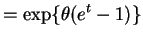
$\displaystyle X \sim$   Poisson$\displaystyle (\theta)$   $\displaystyle M_{X}(t)$ $\displaystyle = \exp\{\theta(e^{t}-1)\}$    
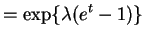
$\displaystyle Y \sim$   Poisson$\displaystyle (\lambda)$   $\displaystyle M_{Y}(t)$ $\displaystyle = \exp\{\lambda(e^{t}-1)\}$    

so

$\displaystyle M_{X+Y}(t) = \exp\{(\theta+\lambda)(e^{t}-1)\}$    

and thus $ X+Y$ is Poisson( $ \theta+\lambda$). Now

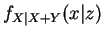
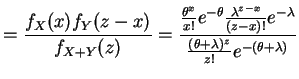
$\displaystyle f_{X\vert X+Y}(x\vert z)$ $\displaystyle = \frac{f_{X}(x)f_{Y}(z-x)}{f_{X+Y}(z)} = \frac{\frac{\theta^{x}}...
...x}}{(z-x)!}e^{-\lambda}} {\frac{(\theta+\lambda)^{z}}{z!}e^{-(\theta+\lambda)}}$    
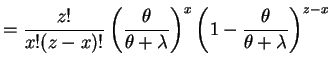
  $\displaystyle = \frac{z!}{x!(z-x)!} \left(\frac{\theta}{\theta+\lambda}\right)^{x} \left(1-\frac{\theta}{\theta+\lambda}\right)^{z-x}$    

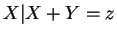
for $ 0 \le x \le z$. So $ X\vert X+Y=z$ is Binomial( $ z,\theta/(\theta+\lambda)$).

4.17
a.
For $ y=1,2,\ldots$,

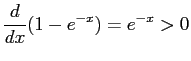
$\displaystyle f_{Y}(y) = P(y-1<X<y) = e^{-(y-1)}-e^{-y}=e^{-(y-1)}(1-e^{-1})$    

So $ Y$ is geometric( $ p=1-e^{-1}$).
b.

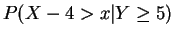
$\displaystyle P(X-4>x\vert Y \ge 5)$ $\displaystyle = P(X-4>x\vert X \ge 4)$    
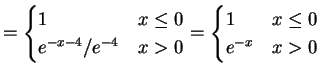
  $\displaystyle = \begin{cases}1 & x \le 0 e^{-x-4}/e^{-4} & x > 0 \end{cases} = \begin{cases}1 & x \le 0 e^{-x} & x > 0 \end{cases}$    

This is an exponential distrbution.

For any $ t$, $ X-t\vert X \ge t$ is Exponential(1).

4.36
a., b.
Suppose the $ P_i$ are independent random variables with values in the unit interval and common mean $ \mu$. Since the $ P_i$ are independent and each $ X_i$ only depends on $ P_i$, the $ X_i$ are marginally independent as well. Each $ X_i$ takes on only the values 0 and 1, so the marginal distributions of the $ X_i$ are Bernoulli with success probability

$\displaystyle P(X_i = 1) = E[P(X_i=1\vert P_i)] = E[P_i] = \mu$    

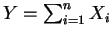
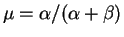
So the $ X_i$ are independent Bernoulli($ \mu$) random variables and therefore $ Y=\sum_{i=1}^n X_i$ is Binomial($ n$, $ \mu$). If the $ P_i$ have a Beta($ \alpha$,$ \beta$) distribution then $ \mu =
\alpha/(\alpha+\beta)$ and therefore

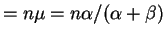
$\displaystyle E[Y]$ $\displaystyle = n \mu = n \alpha/(\alpha+\beta)$    
Var$\displaystyle (Y)$ $\displaystyle = n \mu (1 - \mu) = n \alpha \beta / (\alpha + \beta)^2$    

c.
For each $ i = 1, \dots, k$

$\displaystyle E[X_i]$ $\displaystyle = E[E[X_i\vert P_i]] = E[n_iP_i] = n_iE[P_i] = n_i \frac{\alpha}{\alpha+\beta}$    
Var$\displaystyle (X_i)$ $\displaystyle = E[$Var$\displaystyle (X_i\vert P_i)] +$   Var$\displaystyle (E[X_i\vert P_i])$    
  $\displaystyle = E[n_i P_i(1-P_i)] +$   Var$\displaystyle (n_iP_i)$    
  $\displaystyle = n_i E[P_i(1-P_i)] + n_i^{2}$Var$\displaystyle (P_i)$    
  $\displaystyle = n_i \int_{0}^{1}\frac{\Gamma(\alpha+\beta)}{\Gamma(\alpha)\Gamm...
...)^{\beta+1-1}dp + n_i^{2}\frac{\alpha\beta}{(\alpha+\beta)^{2}(\alpha+\beta+1)}$    
  $\displaystyle = n_i \frac{\Gamma(\alpha+\beta)}{\Gamma(\alpha)\Gamma(\beta)} \f...
...alpha+\beta+2)} + \frac{n_i^{2}\alpha\beta}{(\alpha+\beta)^{2}(\alpha+\beta+1)}$    
  $\displaystyle = \frac{n_i\alpha\beta}{(\alpha+\beta)(\alpha+\beta+1)} + \frac{n_i^{2}\alpha\beta}{(\alpha+\beta)^{2}(\alpha+\beta+1)}$    
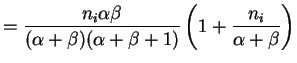
  $\displaystyle = \frac{n_i\alpha\beta}{(\alpha+\beta)(\alpha+\beta+1)} \left(1+\frac{n_i}{\alpha+\beta}\right)$    
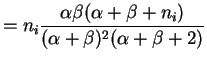
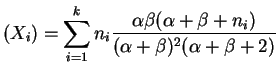
  $\displaystyle = n_i \frac{\alpha\beta(\alpha+\beta+n_i)}{(\alpha+\beta)^2(\alpha+\beta+2)}$    

Again the $ X_i$ are marginally independent, so

$\displaystyle E[Y]$ $\displaystyle = \sum E[X_i] = \frac{\alpha}{\alpha+\beta}\sum_{i=1}^k n_i$    
Var$\displaystyle (Y)$ $\displaystyle = \sum$   Var$\displaystyle (X_i) = \sum_{i=1}^k n_i \frac{\alpha\beta(\alpha+\beta+n_i)}{(\alpha+\beta)^2(\alpha+\beta+2)}$    

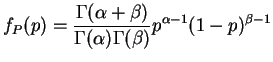
The marginal distribution of $ X_i$ is called a beta-binomial distribution. The density of $ P_i$ is

$\displaystyle f_{P}(p) = \frac{\Gamma(\alpha+\beta)}{\Gamma(\alpha)\Gamma(\beta)} p^{\alpha-1}(1-p)^{\beta-1}$    

for $ 0 < p < 1$. So the PMF of $ X_i$ is

$\displaystyle P(X_i = x)$ $\displaystyle = E[P(X_i = x\vert P_i)] = E\left[\binom{n_i}{x}P_i^x(1-P_i)^{n_i-x}\right]$    
  $\displaystyle = \int_{0}^{1}\binom{n_i}{x}p^{x}(1-p)^{n_i-x} \frac{\Gamma(\alpha+\beta)}{\Gamma(\alpha)\Gamma(\beta)} p^{\alpha-1}(1-p)^{\beta-1} dp$    
  $\displaystyle = \binom{n_i}{x}\frac{\Gamma(\alpha+\beta)}{\Gamma(\alpha)\Gamma(\beta)} \frac{\Gamma(\alpha+x)\Gamma(\beta+n_i-x)}{\Gamma(\alpha+\beta+n_i)}$    

4.21
$ R^{2} \sim \chi^{2}_{2} =$   Gamma$ (1,2) =$   Exponential$ (2)$ and $ \theta \sim$   Uniform$ (0,2\pi)$.

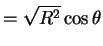
$\displaystyle X$ $\displaystyle = \sqrt{R^{2}}\cos\theta$    
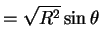
$\displaystyle Y$ $\displaystyle = \sqrt{R^{2}}\sin\theta$    
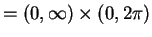
$\displaystyle \mathcal{A}$ $\displaystyle = (0,\infty) \times (0,2\pi)$    
$\displaystyle \mathcal{B}$ $\displaystyle = \mathbb{R}^{2}$    

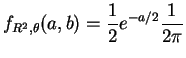
The joint density of $ R^{2}, \theta$ is

$\displaystyle f_{R^{2},\theta}(a,b) = \frac{1}{2}e^{-a/2}\frac{1}{2\pi}$    

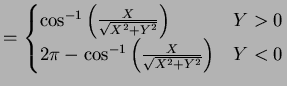
for $ (a,b) \in \mathcal{A}$. The inverse transformation is

$\displaystyle R^{2}$ $\displaystyle = X^{2}+Y^{2}$    
$\displaystyle \theta$ $\displaystyle = \begin{cases}\cos^{-1}\left(\frac{X}{\sqrt{X^{2}+Y^{2}}}\right)...
...0 2\pi-\cos^{-1}\left(\frac{X}{\sqrt{X^{2}+Y^{2}}}\right) & Y < 0 \end{cases}$    

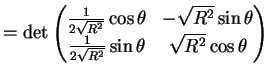
This is messy to differentiate; instead, compute

$\displaystyle J^{-1}$ $\displaystyle = \det \begin{pmatrix}\frac{1}{2\sqrt{R^{2}}}\cos\theta & -\sqrt{...
...ta \frac{1}{2\sqrt{R^{2}}}\sin\theta & \sqrt{R^{2}}\cos\theta \end{pmatrix}$    
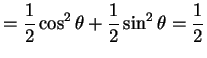
  $\displaystyle = \frac{1}{2}\cos^{2}\theta+\frac{1}{2}\sin^{2}\theta=\frac{1}{2}$    

So $ J=2$, and

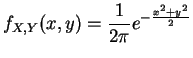
$\displaystyle f_{X,Y}(x,y)=\frac{1}{2\pi}e^{-\frac{x^{2}+y^{2}}{2}}$    

Thus $ X,Y$ are independent standard normal variables.

4.28
a.

$\displaystyle U$ $\displaystyle = \frac{X}{X+Y}$ $\displaystyle \mathcal{A}$ $\displaystyle = \mathbb{R}^{2}$    
$\displaystyle V$ $\displaystyle = X+Y$ $\displaystyle \mathcal{B}$ $\displaystyle = \mathbb{R}^{2}$    
$\displaystyle X$ $\displaystyle = UV$    
$\displaystyle Y$ $\displaystyle = V-UV = (1-U)V$    

So

$\displaystyle \vert J(u,v)\vert = \left\vert\det \begin{pmatrix}v & u -v & 1-u \end{pmatrix} \right\vert = \vert v(1-u)+uv\vert = \vert v\vert$    

Thus

$\displaystyle f_{U,V}(u,v) = f_{X,Y}(uv,(1-u)v)\vert v\vert = \frac{1}{2\pi}e^{-\frac{1}{2}u^{2}v^{2}-\frac{1}{2}(1-u)^{2}v^{2}}\vert v\vert$    

and

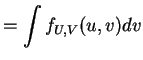
$\displaystyle f_{U}(u)$ $\displaystyle = \int f_{U,V}(u,v)dv$    
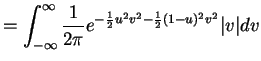
  $\displaystyle = \int_{-\infty}^{\infty}\frac{1}{2\pi} e^{-\frac{1}{2}u^{2}v^{2}-\frac{1}{2}(1-u)^{2}v^{2}}\vert v\vert dv$    
  $\displaystyle = 2 \int_{0}^{\infty}\frac{1}{2\pi} \exp\left\{-\frac{v^{2}}{2}(1+2u^{2}-2u)\right\}v dv$    
  $\displaystyle = \frac{1}{\pi(1+2u^{2}-2u)} = \frac{1}{\pi(\frac{1}{2}+2(u-1/2)^{2})} = \frac{2}{\pi(1+4(u-1/2)^{2})}$    

This is a Cauchy(1/2,1/2) density.
b.

$\displaystyle U$ $\displaystyle = X/\vert Y\vert$    
$\displaystyle V$ $\displaystyle = Y$    
$\displaystyle X$ $\displaystyle = U\vert V\vert$    
$\displaystyle Y$ $\displaystyle = V$    

with $ \mathcal{A}=\mathcal{B}=\mathbb{R}^{2}$. So

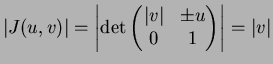
$\displaystyle \vert J(u,v)\vert = \left\vert\det \begin{pmatrix}\vert v\vert & \pm u 0 & 1 \end{pmatrix} \right\vert = \vert v\vert$    

and

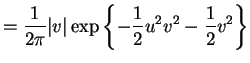
$\displaystyle f_{U,V}(u,v)$ $\displaystyle = \frac{1}{2\pi}\vert v\vert \exp\left\{-\frac{1}{2}u^{2}v^{2}-\frac{1}{2}v^{2}\right\}$    
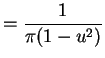
$\displaystyle f_{U}(u)$ $\displaystyle = \frac{1}{\pi(1-u^{2})}$    

4.29
a.
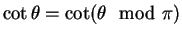
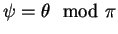
$ U = X/Y = \cos \theta / \sin \theta = \cot \theta$. $ \cot \theta$ is one to one on $ [0,\pi)$, and periodic with period $ \pi$. So $ \cot \theta = \cot (\theta \mod \pi)$. Since $ \psi =
\theta \mod \pi$ is uniformly distributed on $ [0,\pi)$ and $ \cot
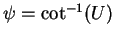
\psi$ is one to one on $ [0,\pi)$ we have $ \psi = \cot^{-1}(U)$ and the density of $ U$ is

$\displaystyle f_U(u) = f_\psi(\cot^{-1}(U)) \vert\frac{d \cot^{-1}(u)}{du}\vert = \frac{1}{\pi}\frac{1}{1+u^2}$    

which is a standard Cauchy density.
b.
$ U = 2XY/\sqrt{X^2+Y^2} = 2 R \sin\theta\cos\theta = R
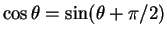
\sin 2\theta$. Since $ \sin\theta$ and $ \cos\theta$ are periodic with period $ 2\pi$ and since $ \cos \theta = \sin (\theta +\pi/2)$ we have

$\displaystyle \cos \theta$ $\displaystyle = \sin(\theta+\pi/2) = \sin((\theta +\pi/2) \mod 2\pi)$    
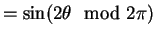
$\displaystyle \sin 2\theta$ $\displaystyle = \sin (2\theta \mod 2\pi)$    

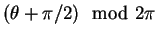
Since both $ (\theta +\pi/2) \mod 2\pi$ and $ 2\theta \mod 2\pi$ are uniformly distributed on $ [0, 2\pi)$ this shows that $ \cos\theta$, $ \sin\theta$ and $ \sin 2\theta$ all have the same marginal distribution, and therefore $ X=R\sin\theta$ has the same distribution as $ R\sin 2\theta$.


next up previous
Link to Statistics and Actuarial Science main page
Next: Assignment 11 Up: 22S:193 Statistical Inference I Previous: Assignment 10
Luke Tierney 2004-12-03